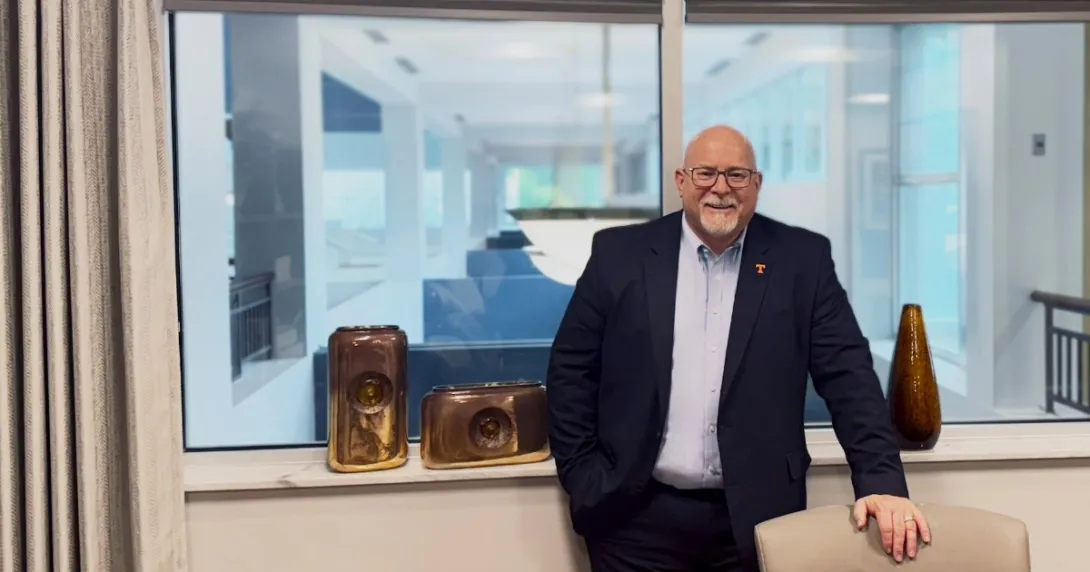
Barry Mathis, managing principal of IT advisory consulting at PYA, a healthcare management consulting firm
Photo: PYA
Over 30 years, the electronic health records landscape has transformed repeatedly, shifting from locally hosted systems to enterprise platforms, and now toward cloud-based ecosystems infused with artificial intelligence, analytics and real-time interoperability.
Throughout this evolution, the fundamentals of EHR success have become clearer, said Barry Mathis, managing principal of IT advisory consulting at PYA, a healthcare management consulting firm.
Mathis said these fundamentals are that governance must be intentional, process redesign drives the value, change management is nonnegotiable and data strategy now dictates organizational agility.
We spoke with Mathis to get his insights on these fundamentals – insights gleaned from more than three decades completing nearly 300 EHR system selections and EHR implementation projects, spanning community hospitals, large health systems, specialty practices and multi-site ambulatory groups.
Q. Governance must be intentional, you say with regard to EHRs. Please elaborate.
A. Intentional governance means governance is not something you "have" but something you actively design, implement and sustain with purpose. I have personally worked with too many organizations that mistake functional committees, IT meetings and ad hoc discussions for governance.
Intentional governance is an operating discipline that establishes how decisions are made, who makes them, how success is defined and how accountability is enforced. When it comes to electronic health records, that means having clear structures that connect operational leaders, clinicians, IT, compliance, finance and quality – not just as advisors but also as shared decision-makers with defined scopes and responsibilities.
Governance must also include a feedback mechanism that gives frontline users a voice without turning every complaint into a customization request.
Intentional EHR governance also requires a balance between central control and local needs. While standardization improves safety, data integrity and supportability, successful organizations still create structured pathways for operational innovation at the department level.
This structure prevents "shadow IT" and "rogue builds" while still allowing for workflow innovation aligned with the organization's strategy. Governance shouldn't just say "no"; it should also help leaders say, "Yes, but with standards," or "Yes, but only if this aligns with measurable clinical or workforce benefits."
Q. Additionally, you believe process redesign drives the value, not the EHR software. What has worked here across the provider organizations you have worked with?
A. An EHR is a mirror. It reflects the quality of your processes – garbage in/garbage out, or quality in/quality out. If those clinical, financial or administrative processes are inefficient, building them into an advanced digital system simply automates dysfunction.
Provider organizations I have worked with, and that have successfully extracted value from their EHR, did not start with software applications – they started with process. They spent time defining the desired state of care delivery, documentation, handoffs, scheduling, billing and communication before ever touching build.
They focused on simplifying workflows, removing unnecessary handoffs, and ensuring tasks fall to the right level of licensure and skill – not just whoever has time.
What has worked best is when organizations treat EHR implementation or optimization as an opportunity for care model redesign. For example, instead of asking, "How do we document in the new system," effective organizations ask, "How should care be delivered, to whom, by whom and in what order?"
They revisit roles: Should physicians be doing clerical work? Should nurses be manually tracking tasks that could be triggered automatically? They reaffirm principles of clinical standardization, reducing variations that introduce risk and hinder interoperability. The EHR becomes the final expression of redesigned workflows, not the starting point.
Q. Change management is nonnegotiable, you strongly state. Please talk about why, and how it can be handled most effectively in the realm of EHRs.
A. EHRs are as much cultural transformations as they are technological ones. Change management is essential because EHRs touch virtually every function in healthcare: clinical workflows, communication, billing, compliance, patient experience and even professional identity.
Asking physicians to adopt structured documentation, standard order sets or analytics-driven decision support isn't just changing tools – it's also changing how they practice. Without strong disciplined change management, resistance and fatigue creep in, not because people oppose progress but because they don't see how the change advances their mission of caring for patients.
Effective change management in EHRs must address the "why," not just the "what." It's not enough to train users where to click – and these days, there are a lot of clicks. They must be shown how standardized documentation improves communication, how decision support reduces cognitive burden, and how well-built data leads to better outcomes and lower denied claims.
Organizations that succeed in change management deliberately shift the narrative from "IT is making us change" to "we are designing our own future state." People support what they help build and resist what is built for them.
Q. Finally, you've said data strategy now dictates organizational agility. Please explain, including an example from your considerable work.
A. In healthcare, strategy used to mean capital planning, workforce planning and facility planning. Today, it increasingly means data planning, too. Organizations that treat data as a byproduct of documentation remain reactive: They can only analyze after the fact.
Organizations with a true data strategy are proactive: They intentionally design workflows so the data they capture can drive operational, financial and clinical decisions in real time. In modern EHR environments, agility isn't about how fast you type; it's about how fast you can learn, decide and change direction.
Organizational agility becomes visible when data is standardized, interoperable and trusted. For example, one multi-hospital system I worked with standardized its nursing documentation and care pathways across its facilities. This didn't only improve data consistency; it also built a foundation for predictive analytics.
Over time, organizational leaders were able to use EHR data to identify high-risk admissions, preempt discharge delays and reduce unnecessary readmissions. When COVID hit, this same data capability allowed them to repurpose capacity, redesign workflows, and forecast staffing based on reliable, real-time clinical indicators.
In short, digital maturity is no longer defined by having an EHR. Maturity is defined by being able to put that EHR to work.
Follow Bill's health IT coverage on LinkedIn: Bill Siwicki
Email him: bsiwicki@himss.org
Healthcare IT News is a HIMSS Media publication.
WATCH NOW: EHR transitions: How to ensure adoption and satisfaction


