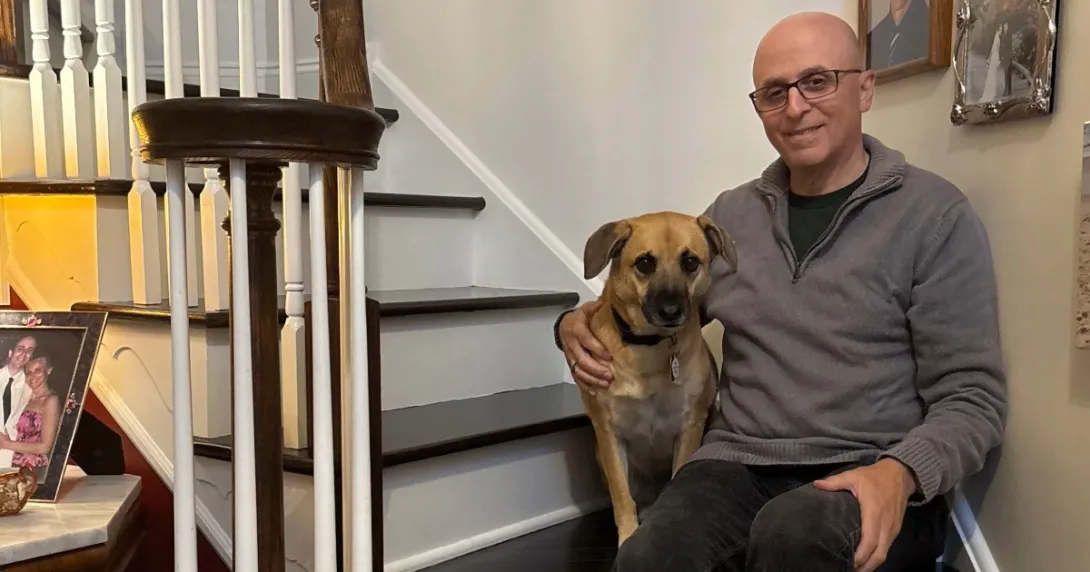
Lexi and her best friend Dr. Jonathan M. Sternlieb, an Epic Emeritus CMIO
Photo: Dr. Jonathan M. Sternlieb
It's not uncommon for chief information officers, chief medical information officers and other health IT leaders to enlist the help of consultants for big projects, such as electronic health record implementations or optimizations.
As we've been reporting here recently, one valuable but perhaps underappreciated source for such EHR advisors is the Epic Emeritus CIO or CMIO program. With it, the company connects retired Epic executives and clinicians with healthcare organizations to provide strategic advisory services, fill interim leadership roles and support critical projects like go-lives and optimization.
This week, we spoke with Epic Emeritus CMIO Dr. Jonathan M. Sternlieb. He's a recently retired GI physician, and longtime informaticist who has served in the CMO and CMIO capacities, most recently at Thomas Jefferson University Hospitals. As a physician informaticist and former CMIO, he views his advisory role as it relates to non-physician health IT disciplines as an important aide.
Everyone with a stake in success
"I resonate with all of those who have a stake in the success of a project, regardless of their reporting structure," he said. "Health IT covers a broad spectrum of disciplines and people. In fact, the teams that make up health IT come from all walks of life.
"They might have been and might still be clinicians," he continued. "I often preface conversations with, 'I may not have your expertise, and vice versa for that matter.' We need to have a high level of understanding of what we do and understand our expectations. We need to be visible, available, a good listener and an empathizer."
Professional advisors can fall short of that, he added.
"I'm guilty of that as well, and I need to remember that with all interactions," he said. "Follow-up and closing the loop are key, even if it includes hand-off to others.
"Stress that all roles are important, whether those individuals directly touch patient care or they have second or third order function to patient care, because all of the efforts impact the success of the project, which has that impact on patient care and the providers and clinicians who deal with patients on a regular basis."
Tactics on a limited schedule
When an engagement with a hospital or health system is of limited time – perhaps two weeks or less – Sternlieb uses key tactics that lead to collaboration and trust when he is trying to become part of an on-site team. These are tactics he says CMIOs, CIOs and other health IT leaders at provider organizations also can use to succeed.
"In the Epic Emeritus Program, most of my engagements are in those bursts of shorter periods of time, one to two weeks," he explained. "There are opportunities for longer engagements. I'm focusing more on these shorter on-site engagements to support go-lives.
"So, with that as a backdrop, there's a very short onboarding timeline," he continued. "You need to think about this differently. And you need to have a realistic goal of what is able to be achieved. You're coming on site, and you're meeting a group of people who are working together, typically, and they've never met you before. They might have seen your name on a spreadsheet."
That is meaningless from a human factor perspective, Sternlieb added.
Listen, support, connect
"I stress that I'm there to listen, absorb, support and connect," he said. "It goes to a lot of sociological factors. I'm not necessarily the tech expert. In fact, I tell people, I may not know the answer to all of your questions immediately.
"I need to recognize, and I think we all need to recognize, that we're working on their terms and turf," he continued. "This is not my home institution. It's theirs, and that needs to be respected, if not celebrated."
Sternlieb solicits feedback early and frequently.
"It's very important to ask good questions, to inquire about someone's role and their history within an organization," he noted. "People are often very proud to tell you their story, and you need to show genuine interest. And that's not hard to do.
"I'm keenly interested in the members' stories of how it got them to that point in time," he added. "I would say that a response of 'Thank you for listening' is often as powerful as 'Thank you for solving.'"
Lessons for any EHR deployment
Sternlieb has learned many important lessons working with provider organization teams to deploy EHRs – lessons any health IT executive can use with any EHR deployment.
"This is transcendent of all platforms and vendors," he explained. "It's critically important to engage with the medical, nursing and all clinical administrative leadership early and often – a common theme and underpinning building these relationships and building trust.
"And this can't be overstated: A common theme is active listening and soliciting feedback," he continued. "Be realistic about what is possible and when it is possible. Not everything is possible or feasible, and that needs to be highlighted early in any initiative. No one likes change except a baby with a dirty diaper."
Exhaustion
Going into these types of projects, Sternlieb notices that people often look exhausted.
"They're concerned about the success of a project, but you need to help with change management and understand they're going through a difficult time," he said. "It's very challenging to unfreeze the status quo, even if certain processes persist. That whole concept of change management has a basis in science and reality, and I think you need to bring that to the surface and have everyone understand that.
"It's been very important in my journey to study leadership skills and learn from your successes, but even more important, from your opportunities or your misses," Sternlieb continued. "'Experience is learning to recognize a mistake every time you repeat it.' However, we're all human, and I think teams are different when you go on site."
Know how to deal with interactions that can be disruptive or painful, he added.
"We all can dip deeply into our brainstem – those primitive instincts we just get overpowered with emotion," he said. "And I think it's important to help people get through those hard times that occur during these stressful events.
What does success look like?
So how does Sternlieb define success with an EHR implementation? He said that's a very commonly asked question and an important one to answer.
"Implementation is a bridge to an entirely new place or an overhauled existing model," he explained. "Nonetheless, all bridges need maintenance, and I always use the metaphor of bridge painting. And that theoretically should never end if you want to maintain that bridge.
"You need to bring your constituents to the point of the end of the beginning, the end of an implementation," he continued. "Even though projects have a start and an end date, the work continues, and you need to have realistic expectations of newly minted users. Yes, metrics are absolutely critical, and they need to resonate and be meaningful."
Showing spreadsheets or showing bar graphs to active clinicians who are getting to a meeting 10 minutes late because they ended office hours late, and showing all the successes in the implementation may not resonate with them, he added. What they're concerned about is how this is impacting their patients' lives and their personal and professional lives, he said.
Generational expectations
"And recognize different generations have unique values and expectations," Sternlieb noted. "I'm a baby boomer. I was raised on paper, and I've often stated that charts used to be meaningful but often illegible.
"Charts now are legible but may not be as meaningful," he continued. "Unless you can sift and sort through all that information overload. But to be honest, that's what brought me to informatics was the fragmentation of healthcare and the lack of information."
Today there is a different type of situation where there is plenty of information, and one needs to be able to filter through it, he added.
"The success of that implementation is multiphasic," he concluded. "You can celebrate it during that implementation, but it really goes long beyond that command center closure, and you need to continue that engagement with your constituents."
Click here to watch a brief video of bonus content where Epic Emeritus CMIO Dr. Jonathan M. Sternlieb offers historical context to health IT for health IT professionals and takeaways that can foster stronger multidisciplinary IT-oriented teams.
Follow Bill's health IT coverage on LinkedIn: Bill Siwicki
Email him: bsiwicki@himss.org
Healthcare IT News is a HIMSS Media publication.
WATCH NOW: Lessons from decades in health IT from an Epic Emeritus CMIO


