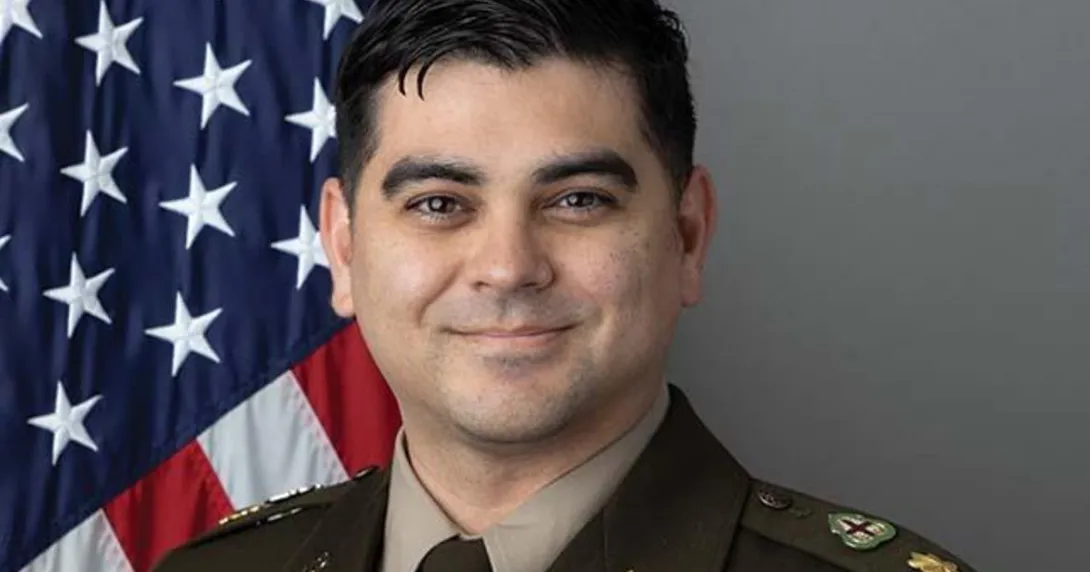
Bruce Barnes, CIO at Brooke Army Medical Center
Some may still think of academic study as confined to the proverbial "ivory tower," set apart from the challenges of the real world – not least the harsh realities of day-to-day healthcare delivery.
But it's also true that the thinking and communication skills learned in the classroom are often the same ones that can enable success in the hospital command suite or health system boardroom.
At the upcoming 2026 HIMSS Global Health Conference & Exhibition, scheduled for March 9-12 in Las Vegas, the chief information officer of Brooke Army Medical Center will offer a discussion focused on the values of academic achievement – research, critical thinking, curriculum design – and how they can be translated into tangible benefits in the workplace.
The session is meant for "anyone who sits at the intersection of talent, technology and strategy," said Bruce Barnes, PhD, who serves as CIO at BAMC, the Department of Defense's largest medical facility and only Level 1 trauma center.
"It’s for hiring managers to understand the benefits of a PhD, IT professionals curious about the value of going back and getting an advanced degree, and for my colleagues in academia who want to see a direct line from their research and teaching to the boardroom," said Barnes about his HIMSS26 talk, "From PhD to CIO: Academia Lessons for the IT Leader."
Barnes holds a BS and a MS in Information Technology and earned his PhD in Business Administration with a specialty in IT from the University of Hawai’i at Manoa. His dissertation research was on electronic health record systems, and he has a keen interest in research on human-computer interaction.
As a lieutenant colonel in the United States Army, he has served as an adjunct lecturer and assistant professor, teaching with the MHA/MBA Army Baylor Graduate Program.
At HIMSS26, Barnes hopes healthcare IT leaders of all stripes will learn from his session.
"The goal is for everyone to leave with a clearer understanding of how academic discipline translates into professional excellence and tangible results," he said.
Skills learned in academia can have a crucial role to play in health IT leadership careers, said Barnes.
"A significant portion of any leadership role is explaining the 'why' and 'how' of a change to diverse audiences," he said. "In the classroom, you learn to distill complex topics into clear, succinct messages, a skill that is invaluable in the boardroom.
"Research trains you to build a case of evidence from peers, academia or case studies, leading to well-supported solutions that secure funding and buy-in," he added. "And curriculum design is, at its core, problem decomposition. It's the art of deconstructing a massive challenge into manageable, sequential modules that you can execute and solve step-by-step."
Moreover, certain core competencies are in demand in both the academic and professional worlds, said Barnes.
"First is solution-focused problem-solving. In both an applied research project and a go-live, the goal isn't to admire the problem; it's to systematically find a path to a feasible resolution. What’s the end state, and what can we do with the resources we have to get there?
"The other is critical thinking with supported data. Academia doesn't accept a thesis without evidence, and the boardroom shouldn't accept a multimillion-dollar project proposal without it either. Both environments demand that your argument is built on a foundation of fact, not just intuition."
Bruce Barnes' session, "From PhD to CIO: Academia Lessons for the IT Leader," is scheduled for Wednesday, March 11, from 11 am.-noon in Palazzo I/Level 5 at the Venetian at HIMSS26 in Las Vegas.
Mike Miliard is executive editor of Healthcare IT News
Email the writer: mmiliard@himss.org
Healthcare IT News is a HIMSS publication.


