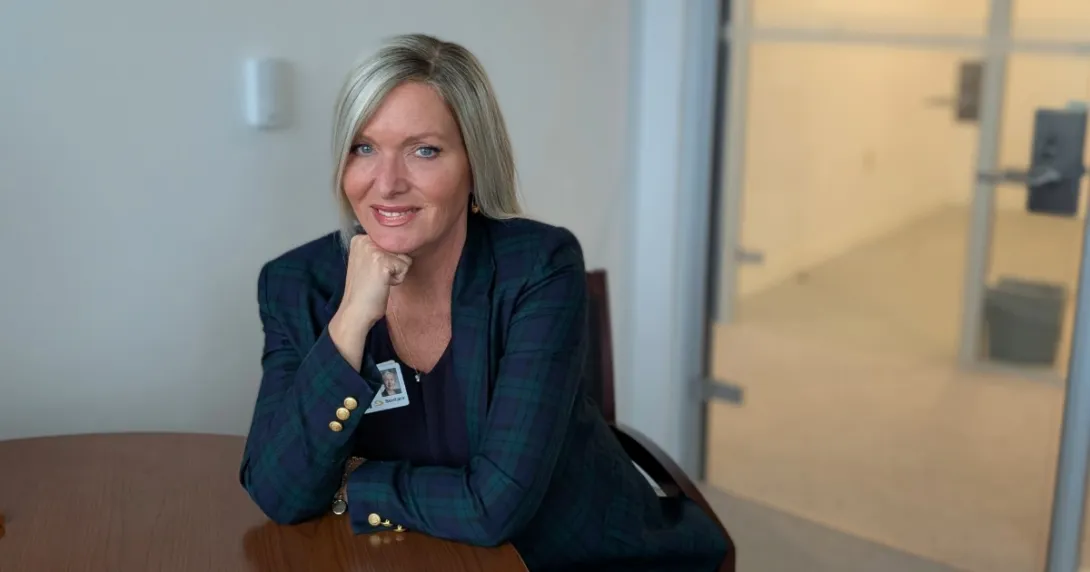
Amber Price, DNP, CNM, RN, senior vice president and chief nursing officer at Sentara Health
Photo: Sentara Health
Sentara Health nursing teams were facing significant challenges related to recruitment and retention. As the health system began exploring technologies to help solve the problems, things became clear – achieving greater standardization in care delivery and EHR documentation were equally critical.
THE CHALLENGE
This realization underscored the need to dismantle longstanding operational silos and align stakeholders across the organization, said Amber Price, DNP, CNM, RN, senior vice president and chief nursing officer at Sentara Health.
In a large health system with 34,000 employees, driving consistent practice change at speed is inherently complex – establishing unified processes with a shared sense of urgency became a foundational priority, she added.
PROPOSAL
As Sentara committed to implementing a virtual nursing platform and the downstream integration of AI‑driven initiatives in acute care environments, staff quickly recognized that limited technology and AI literacy among frontline teams represented an immediate and significant barrier to success.
"Our nurse leadership team made an early strategic decision to create full transparency around the initiative and leverage our robust shared governance structure to align nurses across the enterprise to the vision," Price recalled.
"We understood that this transformation would be as challenging and as consequential as the historic shift from paper charting to electronic documentation, and we approached the work with that institutional memory in mind," she continued.
To build a strong foundation for frontline decision-making, Sentara convened nursing representatives from every domain across the organization. Together, they developed an agreed-on set of guiding principles for virtual and AI implementation to anchor the effort and ensure all stakeholders understood the objectives, expectations and intended impact of the new care model.
"Once these principles were refined and endorsed through our shared governance process, we disseminated them broadly, beginning with our nurse executive council and then cascading to nursing and operational leaders throughout the system," she explained. "This deliberate and inclusive approach ensured early alignment, reduced uncertainty and positioned our teams for a successful transition."
MEETING THE CHALLENGE
At the outset, the nursing team focused on defining the core purpose – the organization's "why."
"We centered this vision on optimizing the healing environment for patients, with an ultimate goal of creating an invisible care model that reduces unnecessary disruptions, minimizes room entries, and limits avoidable surface touches within the patient space," Price said. "This approach reflects our commitment to enhancing both patient experience and clinical outcomes by fostering a calmer, safer and more seamless care environment.
"Each of our technology and artificial intelligence initiatives undergoes a rigorous evaluation process that includes review by our risk and privacy teams, finance leaders and clinical leadership," she continued. "We pilot every initiative within a single facility to gather real‑time feedback from frontline nurses and to assess operational impact before broader deployment."
One challenge Sentara continues to face is the absence of national benchmarks for emerging virtual and AI‑enabled care roles. In response, it is developing internal standards grounded in frontline experience and data.
"For example, we asked our nurses to determine how many patients a virtual nurse can reasonably round on when also responsible for duties, such as taking virtual reports and supporting medication verification workflows," she explained.
"Their feedback indicated that one virtual nurse with a full assignment can complete rounds on 21 patients every other rounding cycle," she said. "With these emerging benchmarks, we are beginning to define what a virtual nurse full‑time equivalent looks like within our redesigned care model, enabling more accurate staffing, workload planning and resource allocation."
RESULTS
The nursing team identified 11 positions that could be seamlessly transitioned to a virtual platform with minimal disruption, allowing the health system to retain every employee while redeploying their skills in new and meaningful ways.
"As the virtual platform launched, we began tracking the number of hours returned to bedside nursing each day and evaluating how best to reinvest that time to support both patient care and workforce sustainability," Price said.
"Sentara gave 18,000 hours back to floor nurses in year one of the virtual nursing rollout, from more than 59,000 virtual nursing sessions," she reported. "The virtual platform has also sparked new ideas. Once in place, it quickly became a logical solution for challenges extending beyond direct clinical care."
One of Sentara's early innovations has been the development of a virtual chaperone program within the acute care setting, supported by medical assistants from ambulatory clinics. This model not only reduces the burden on acute care nursing staff, but also enables MAs to work at the top of their scope, she added.
"Implementing this program required updates to our documentation processes to allow ambulatory staff to chart within the acute care environment," she noted. "A second major advancement was the introduction of ambient documentation for our virtual nurses, who are currently piloting the technology. Once we achieve a documentation capture rate exceeding 95%, we plan to extend ambient documentation to all frontline bedside staff.
"Every time we pilot something, we learn something," she continued. "We have noted a 6.9% increase in discharges before 1 p.m., which was directly correlated to our increasing utilization of virtual discharges. Our goal is to reduce room entries by as much as 50%, improving patient safety and maximizing nurses' direct care time."
Additionally, for the last quarter of 2025, patients rated their Sentara hospitals 2.9% higher when they received a discharge from a virtual nurse as opposed to in person.
"This newfound knowledge helps us set the benchmarks and further develop the business case for technology in the acute care space," Price concluded.
Follow Bill's health IT coverage on LinkedIn: Bill Siwicki
Email him: bsiwicki@himss.org
Healthcare IT News is a HIMSS Media publication.
WATCH NOW: The model context protocol at work in AI and clinical workflows


