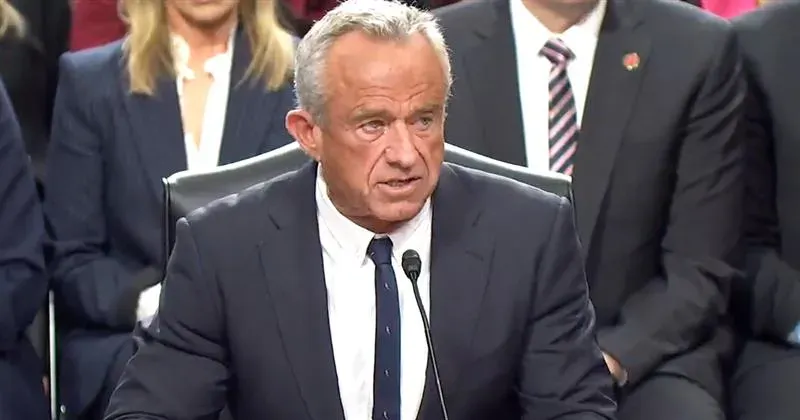
RFK Jr. appeared before the Senate Finance Committee in 2025 on his nomination as HHS secretary.
Photo: Senate Finance Committee screenshot
Traditional Medicare denials are harming patient care in the six states where the U.S. Centers for Medicare & Medicaid Services mandated the use of the Wasteful and Inappropriate Service Reduction (WISeR) Model this year, says Rep. Suzan DelBene, D-Wash.
"Under your leadership, CMS recently added new layers of red tape that Medicare patients need to navigate to get the care that they are entitled to," DelBene told Health and Human Services Secretary Robert F. Kennedy, Jr., during a hearing on Capitol Hill this past week.
Kennedy defended what he says is Medicare's first prior authorization program as a necessary tool to combat fraud and rising costs. But DelBene and other lawmakers have introduced legislation to repeal the WISeR Model, with some likening it to a "Trojan horse" for Medicare privatization.
WHY IT MATTERS
During a lengthy session to discuss the Trump administration's 2027 budget proposal with the House Ways and Means Committee, DelBene pressed Kennedy about the new artificial intelligence-driven prior authorization model, which she said is harming patients with mounting care delays and denials that are not explained.
The FY27 budget proposes $111 billion for HHS, which is said to represent a 12.5% cut from the previous year and includes a $5 billion cut to the National Institutes of Health.
At the hearing, DelBene reminded Kennedy about some 2025 statements where he said Americans shouldn't have to negotiate with their insurers to get what they need. A week later, CMS announced the WISeR Model, which cuts Medicare spending by denying certain services.
The WISeR Model was implemented statewide in Washington, New Jersey, Ohio, Oklahoma, Texas and Arizona earlier this year.
DelBene said that patients in Washington state are waiting weeks for approval under the six-year pilot, which began paying private companies to use AI to authorize and deny certain healthcare services.
For instance, one of her constituents, Joanne, a Medicare patient from Quilcene, Washington, has a herniated disc causing intense pain. "But because of the WISeR Model," she is waiting six weeks for a routine prescribed injection, said DelBene. Joanne may now pay out of pocket for the procedure because, "as she told my office, she 'can’t keep living like this.'"
"I think that is a terrible outcome," Kennedy acknowledged, and then gave an example of rising claims without prior auth that he says necessitates the process.
Kennedy said prior authorization never existed under Medicare, which led to exploding costs for some services.
DelBene said the WISeR Model is "doing exactly what you said shouldn't happen," by incentivizing private companies to deny services, and is hurting patients in her state and across the country, "for no reason."
"Discovering $23 billion worth of fraud is not for no reason," Kennedy responded.
"In just the first few months, the number of stories like Joanne’s, in which care is delayed or denied, have exploded across these six states," DelBene wrote in an op-ed published by MSNow and posted to her website.
DelBene claims the model is a play to privatize Medicare. The private companies involved in the WISeR pilot get paid a share of the costs they save by rejecting claims.
"By injecting private companies into traditional Medicare with the goal of limiting care, the Trump administration is testing a new avenue to privatize the program. Congress must recognize and reject this Trojan horse before it fundamentally reshapes Medicare as we know it," DelBene wrote.
We reached out to the congresswoman's office for specific information on delays and denials from her district's provider constituents.
"That's one of our main concerns is we can't get transparency into how much care is getting denied," a spokesperson for DelBene told Healthcare IT News on Friday. "We're only able to get the anecdotal data."
"Months in, doctors' offices are still in the dark about basic functions of the program, and [HHS] hasn't provided answers to foundational concerns since WISeR was announced last June," DelBene said in the op-ed.
In a letter to CMS Administrator Dr. Mehmet Oz last year after the program was announced, DelBene asked how the contracted entities' algorithms would be reviewed "to ensure that inappropriate denials of medically necessary care do not occur," and what thresholds would CMS impose so that care denials are evidence-based and "not volume-driven."
THE LARGER TREND
This past week, DelBene, along with her colleagues, Rep. Rick Larsen, D-Was.; Rep. Greg Landsman, D-Ohio; Dr. Ami Bera, D-Calif.; Dr. Kim Schrier, D-Wash.; and Mark Pocan, D-Wisc., promoted the Seniors Deserve Streamlined Medical Approvals for Timely, Efficient Recovery (SMARTER) Care Act, their bill proposing to repeal the WISeR Model.
"Seniors shouldn't have to worry about whether AI decides if they get the care they need," Landsman said in their joint announcement.
"It's reckless. Time and again, the Trump Administration is making it harder for Americans to access healthcare – and now they're targeting Medicare, something tens of millions of seniors have paid into and rely on."
"I will continue to fight back against the Trump administration's efforts to privatize Medicare," Larsen added.
Of note, discussions about rising healthcare costs, messaging about autism and vaccines during an increase in measles outbreaks and more became heated during the House hearing last week.
Kennedy said that many lawmakers pressing him on these issues did not give him time to respond to questions, while some lawmakers said the secretary's inability to answer questions or redirect topics signified a lack of preparation.
Others praised Kennedy for his efforts to gain traction on phasing out food dyes through voluntary commitments and advancing nutrition in healthcare.
While Kennedy has two weeks for responses to any issue raised during the session, we did reach out to HHS to ask for a statement responding to DelBene's concerns and will update this story if there is a response.
ON THE RECORD
"We must develop more ways to detect, stop and hold bad actors accountable, but WISeR simply repeats the same flawed tactics that already delay care, frustrate patients and cost us more money," DelBene said in her op-ed.
"Kennedy and HHS seem more focused on enriching private companies with tax dollars that should be going to care for seniors."
Andrea Fox is senior editor of Healthcare IT News.
Email: afox@himss.org
Healthcare IT News is a HIMSS Media publication.


