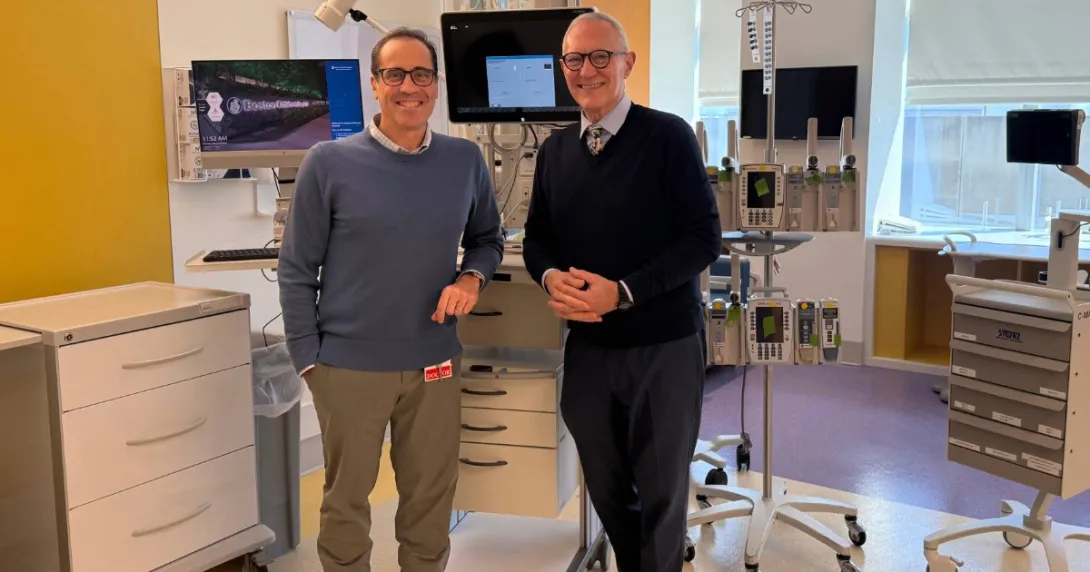
Dr. Josh Salvin (left), chief, division of cardiovascular critical care, and Dr. Peter Laussen, executive vice president, health affairs, at Boston Children's Hospital
Photo: Boston Children's Hospital
At Boston Children's Hospital, in critical care, providers manage children generating high-frequency, time-series data. But they had lacked a way to efficiently store, curate, analyze and bring those signals to the bedside for decision support.
THE CHALLENGE
Much of it would appear on a monitor and effectively disappear, so teams weren't consistently seeing the same picture or understanding how signals interacted over time, which led to varied, heuristic decision-making – and in one case, a delayed decision that resulted in harm, said Dr. Peter Laussen, executive vice president, health affairs, at the hospital.
"Some of our challenges were operational, but many of them were clinical decision support questions, such as, 'How do we know an evolving physiologic state and the risk for an event within that state?'" he explained.
"As we examined our systems, we saw that people weren't seeing data in the same way and weren't appreciating the complexities of what that data signaled, making it hard to recognize evolving physiologic states and imminent risk," he continued. "We needed longitudinal visibility into patient trajectories and a way to zoom in and out, overlay signals, and interpret them coherently so decisions could be made on shared understanding rather than isolated snapshots."
Even basic documentation worked against the providers, said Dr. Josh Salvin, chief, division of cardiovascular critical care, at Boston Children's Hospital.
"Nighttime vitals were often recorded hourly, essentially snapshots influenced by when a nurse could chart, so the morning team tried to reconstruct a 12-hour clinical course from dots on a timeline," he noted. "Without continuous, high-fidelity streams, we couldn't reliably tell, for example, whether oxygen saturation dropped before end‑tidal CO2 or vice versa, which can be differences that might steer you to the OR or reassure you to stay the course."
PROPOSAL
The hospital turned to Etiometry, an AI-driven clinical intelligence platform that employs large language models.
"The initial promise was practical: Establish a trustworthy source of truth by capturing continuous, high-fidelity physiologic data so we could replay events precisely – down to a five-second window – and infer the correct causal sequence," Salvin explained. "Building from that foundation, analytics would scale beyond single-patient forensics to population-level awareness, letting a charge nurse identify hot spots on an overview screen and proactively allocate staff and resources to patients at risk of an unfavorable trajectory."
Equally important, the AI-driven clinical intelligence and analytics were designed not to dictate care but aggregate signals, surface an evolving trajectory and prompt an appropriate response – which could range from heightened situational awareness to a change in management, Laussen said.
"Because ICU patients exhibit enormous biologic variability, the aim was precision critical care: Leverage analytics to tailor decisions to the individual state, reduce noise, and trigger new ways of thinking and educating the team," he continued.
"In short, we expected a common data canvas and trajectory-focused analytics that align the team in real time, without replacing judgment," he added. "That alignment is a systems-level benefit: Everyone 'sees' the same evolving patient, which would reduce inconsistency and delays."
MEETING THE CHALLENGE
Staff operationalized the use of the platform across the entire team as a decision support tool. The platform aggregates signals to indicate trajectories, which tells the clinician to evaluate the patient's evolving state and determine an appropriate response. It can also directly trigger a response to changing management.
"Bedside clinicians use continuous risk indicators to cross-check extubation readiness and vasoactive weaning, while charge nurses rely on unit-level screens to identify patients whose risk is trending the wrong way, reallocating attention before deterioration," Salvin explained.
"In extubation and ventilation weaning, adding AI-driven algorithm findings in addition to the standard practice of looking at breathing rate on a certain ventilator setting has become a powerful secondary measure to support clinician judgment as an additive tool, not an if‑then directive," he added.
A compelling use case is de-escalation of care.
"Patients often remain on vasoactive infusions longer than needed, slowing recovery," Laussen explained. "The intelligent representation of data through the Etiometry Platform has substantially enabled our team to optimize treatment when monitoring something like coronary perfusion pressure.
"In the past, we'd have to manually make calculations intermittently, a process that was too often forgotton or simply at a point in time," he continued. "Now, with constant measurement, we can trend and track coronary perfusion pressure, allowing us to make more targeted decisions about myocardial oxygen delivery and the timing of weaning vasoactive infusions."
Providers know how vasoactive drugs work pharmacologically, but as they're now guided by continuously computed and displayed parameters, they're better able to understand how to use them most effectively, he added.
"Additionally, the integration of the platform has also reshaped our culture and training," Laussen noted. "It has changed how we make rounds, discuss patients and think about the physiology. Where older workflows required deliberate, intermittent calculations, the current generation of clinicians are seeing these continuous trends by default, elevating the conversation and broadening therapeutic options at the point of care."
RESULTS
Operational metrics are inherently site‑dependent, and today Boston Children's still struggles to systematically link every bedside decision made by clinicians to the precise data that informed it.
"Even so, our experience, along with broader reports from other adopters, shows that targeted, data-driven decision making is associated with reductions in ICU length of stay," Laussen said. "The next leap is to pair the 'why' behind decisions with the time-aligned data so future support can recommend actions based on patient-level features rather than inferring intent from physiologic responses alone."
Another advantage not often cited with reducing the length of ICU stay is the long-term benefits a patient feels, Salvin noted.
"There are many studies highlighting how every day spent in the ICU negatively impacts a patient," he said. "Every day can be detrimental for brain development in a baby who's sedated or receiving vasoactive drugs. If we can de-escalate care and shorten the amount of time with a central line or on sedation or vasoactive drugs, then we may be able to impact their long-term development far beyond a critical event warning.
"With extubation, we've shown that adding validated risk analytics can materially reduce failure risk," he continued. "A multi-center study led by Boston Children's Hospital found that elevated Etiometry indices – IDO2 and IVCO2 – in the hours before extubation were associated with increased odds of extubation failure after congenital cardiac surgery."
Incorporating these continuous risk signals with standard assessment helps clinicians time extubation more precisely and lowers the odds of failure – nearly twofold in the hospital's published experience, Salvin reported.
"From an economic lens, external analyses suggest substantial ROI as hospitals scale these tools," he concluded. "Recent modeling using Etiometry's ROI framework, which was based on published outcomes and standardized cost assumptions, estimates around 200% first‑year ROI, more than $2 million in annual savings, more than $20,000 saved per ICU bed per year, and around $3,541–$9,109 in savings per patient, largely via reduced length of stay, shorter ventilation time and freed capacity."
Follow Bill's health IT coverage on LinkedIn: Bill Siwicki
Email him: bsiwicki@himss.org
Healthcare IT News is a HIMSS Media publication.
WATCH NOW: Healthcare leaders offer HIMSS26 insights


