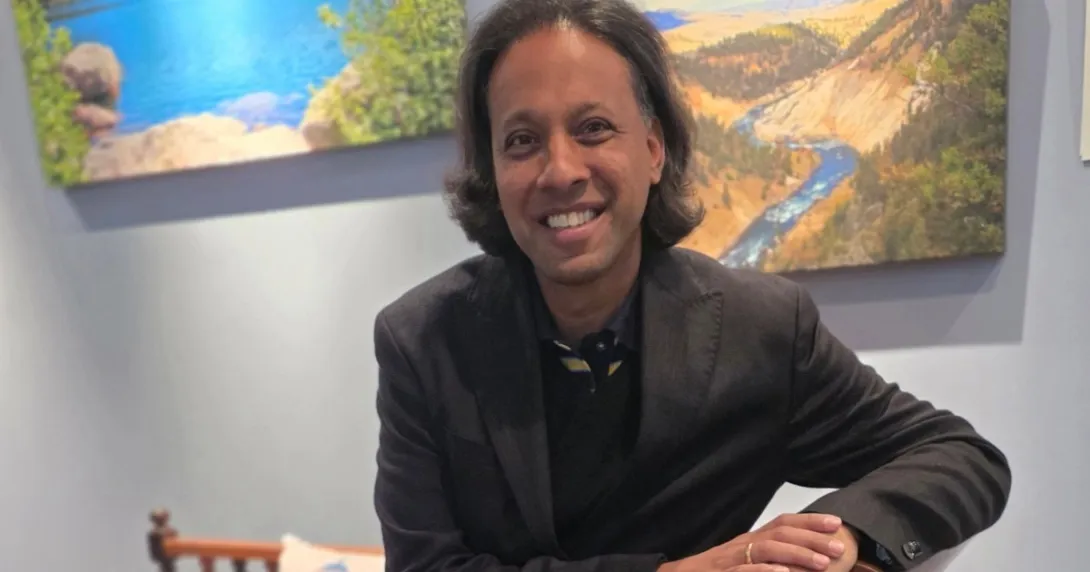
Ascension Chief Analytics and AI Officer Karthik Raja
Photo: Ascension
Editor's Note: This is the ninth and final in our series on Chief AI Officers in Healthcare. Other CAIO profiles include Dennis Chornenky at UC Davis Health, Dr. Karandeep Singh at UC San Diego Health, Alda Mizaku at Children's National Hospital, Dr. Zafar Chaudry at Seattle Children's, Mouneer Odeh at Cedars-Sinai, Sameer Sethi at Hackensack Meridian Health, Rajiv Kolagani at Lurie Children's Hospital, and Charles Worthington of the U.S. Department of Veterans Affairs.
In 2019, Ascension – the St. Louis-based, 100-hospital health system – was transforming from a holding company to an operating company. It had just brought on board a new head of strategy and innovation and it was building out its data and analytics teams.
At that time, Karthik Raja had spent about 15 years at Hewitt Associates and Aon (Aon acquired Hewitt). And he'd spent years in healthcare, benefits outsourcing, health exchanges and population health analytics – working with employers, payers, providers, PBMs and health data vendors.
Ascension was looking for a technologist with healthcare experience, and it liked what it saw in Raja. After about six months of interviews, he joined Ascension in November 2019 as the chief data scientist, reporting to the executive vice president of strategy and innovation.
Then came COVID-19.
A rare event
"The world changed," Raja recalled. "In one's career, a rare event like this might happen, and a calling comes to you."
Raja suddenly was helping lead a health system with more than 100 hospitals, and supporting clinicians, nurses and others caring for thousands of COVID patients,
"We realized we needed to build out a strong data infrastructure and analytics infrastructure," he said. "That's what serves as the foundation for where we are today. And that's how I got my start at Ascension."
Fast-forward five years, and it was in July 2024 when Raja earned the title Chief Analytics and AI Officer.
Much more than math
What made Raja so attractive to Ascension to be the CAIO? For one thing, a background in mathematics. But it was much more than that, he said.
"It's a problem-solving attitude," he explained. "Understanding the problem and being able to identify the class of problems it is, and then applying the right methodology to solve it. This is critical in AI. AI is not one thing. It is a class of problems, and we've got to recognize how to solve particular problems. And the methodology we apply to it.
"Also, what was very important to Ascension was my domain expertise – if it's a healthcare organization, it is important to understand how it works, the economics of it, the clinical aspects, the care," he added. "Now, healthcare is very complex, but you have to spend time learning so you can apply artificial intelligence to solve for the complexity."
'Decision science'
Raja wears the combined chief hat of analytics and AI at Ascension.
"I believe strongly in the domain of decision science," he explained. "You're going to hear decision science come up more in vernacular going forward. This is the art of making decisions. Successful leaders make decisions faster. They have a higher probability of having accurate information to make those decisions from.
"I now report to the CFO and support the Ascension leadership team with advanced analytics, forecasting, modeling, impact analysis and more," he continued. "AI, to me, is really accelerating these capabilities. For years in the data field, we've been talking about democratizing data. AI is finally making that happen."
Raja leads a team of more than 500 associates with responsibility for analytics in various areas including clinical, actuarial, managed care, growth, strategy, throughput, efficiency, productivity and cost. To support all the analytics, the team has developed a proprietary healthcare data intelligence layer.
"And then, most important, to enhance all of these analytics, we have our data science and AI center of excellence," he noted. "So that is my role. That's my responsibility, to really run enterprise-wide analytics with really good data science and the AI center of excellence."
Day in the life
For Raja, a typical day is broken into thirds. One third is spent with Ascension's leaders – understanding current challenges, seeing around the corners for what's coming and bringing opportunities to the forefront. Another third is spent on his team's projects, designing analytic systems, AI models, genAI applications and more.
"We brainstorm methodology, the best tools to use, and ways to implement, communicate and manage change," he said. "Change management is extremely important. We can put a lot of AI things in place, but it's new, and we've got to walk everybody through the change of implementing that."
The last third of his day is for him the most important – developing talent.
"I work with my team on their development areas, enhancing skill sets and capabilities, removing roadblocks where needed, and ensuring we are constantly on the leading edge," Raja explained. "That's a typical day, one-third, one-third, one-third, focusing on opportunity analysis, my work and the teams', and then talent development."
Talent and mission
At Ascension, Raja said, every AI initiative begins with the people, the talent, and is always guided by the mission.
"We believe technology should protect and strengthen the human connection in care," he said. "That's what we aspire to. So, we are using AI to reshape clinical care and quality, enhance the associate experience, accelerate operational processes, and personalize consumer acquisition and retention. Those four things are key to any healthcare organization and specifically for us.
"With each one of those, we have multiple applications in various stages of maturity," he continued. "For example, we are using AI to ease physician burden, give nurses time back for patient care, and provide faster access to the right high-quality care and self-care for our patients. We have AI applications that help us analyze our data faster, improving our associate productivity and making decisions faster."
Raja spoke of decision science. Ascension is using AI to improve the throughput and optimize revenue cycle operations.
AI and the patient experience
"We have to be able to make sure we are efficient in our processes," he explained. "We believe consumers' time is invaluable, especially when they are under the stress of managing their health. So, we're using AI to ease their journey with us.
"As a Catholic, mission-driven organization, our approach is very deliberate," he continued. "We are defining our own path centered on service, integrity and human dignity. And then as AI becomes more integrated into healthcare, we feel a personal responsibility to lead with intention. We are reimagining the future of healthcare."
Ascension is building AI with guardrails, with purpose and with people at the center, he added. And the approach is grounded in ethics, transparency and a deep respect for those being served, he said.
Some aspects of AI, even in the last year as it's matured, have almost become commodities, Raja noted.
"An example of this AI technology is ambient listening," he said. "Ambient listening technology securely captures and transcribes conversations during visits to automatically create documentation. In the pilots we've done, job satisfaction has increased, there are favorable responses to documentation, time has been saved.
"But to me, some of these things are just so mature now that they are really commodities," he continued. "We are very diligent about what is now available within the HR systems, what is provided by best-in-class technology vendors, and then what we must build internally."
What Ascension is developing
AI's biggest jump has been understanding cost and effect, he added.
"A good example of this is we developed AI agents and applications that validate our data – they help us forecast and analyze it, and then identify opportunities and, best of all, provide recommendations," Raja said. "So, think of six different analytic work functions all coming together under different agents performing that work. This reduces our analysts' time considerably.
"They're spending more time providing thought leadership now," he noted. "And then to advance these capabilities, our internal data science and AI center of excellence is a hybrid model with dedicated machine learning, ML-ops, AI-certified experts who standardize application development, along with data scientists who have immense domain expertise. And they use standardized toolsets to solve problems in their domains."
Together, Ascension teams are innovating with AI, Raja stated.
"Every step keeps people at the center," he concluded. "We protect privacy and preserve the compassion and judgment that define Ascension care."
Click here for a brief video of bonus content where Karthik Raja explains the bonds between AI and analytics that make each better and talks whether provider organizations should aim for moonshots or quick wins with AI.
Follow Bill's health IT coverage on LinkedIn: Bill Siwicki
Email him: bsiwicki@himss.org
Healthcare IT News is a HIMSS Media publication.
WATCH NOW: Should providers aim for moonshots or quick wins with AI?


