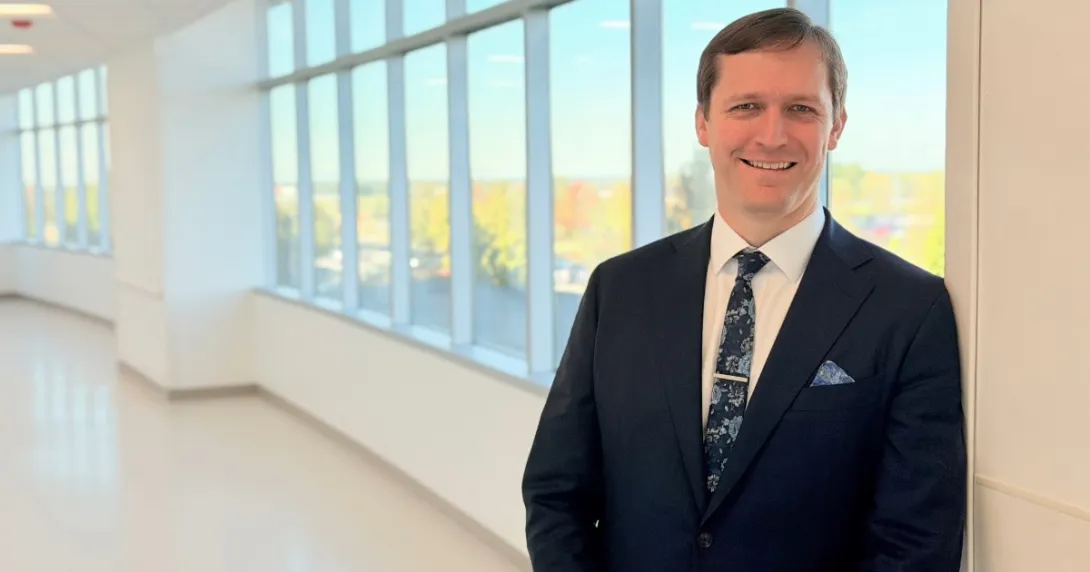
Dr. Markus S. Renno, cardiologist and director of advanced cardiovascular imaging at Arkansas Children's Hospital
Photo: Arkansas Children's Hospital
Approximately 1% of babies are born with some form of significant congenital heart disease. And as they age and get bigger, their follow-up imaging with echocardiography becomes increasingly challenging.
THE CHALLENGE
Not only do acoustic windows for echocardiography worsen as a baby's chest grows, says Dr. Markus S. Renno, cardiologist and director of advanced cardiovascular imaging at Arkansas Children's Hospital, but important aspects of the complex anatomy become difficult to see.
"Though echocardiography remains the workhorse for imaging pediatric and congenital heart disease, cardiac MRI and cardiac CT offer important advantages over echocardiography for an increasing number of cases," Renno explained.
"For instance, guidelines generally recommend use of an advanced cardiovascular imaging modality such as MRI or CT every three to five years in adult-size CHD patients to ensure they receive timely care for complications that commonly arise.
"In addition, cardiac MRI offers important advantages in pediatric patients with cardiomyopathies, especially hypertrophic and dilated cardiomyopathies – these are often genetic and include the cardiomyopathy commonly associated with dystrophinopathies," he continued.
"Similarly, the superior spatial resolution of cardiac CT is preferred for preoperative evaluation of anomalous origins of the coronary arteries in many centers."
The problem is that pediatric and congenital cardiac MRI and CT require significant technical expertise, both in terms of the imaging modality and in terms of the patient's anatomy and history. For this reason, advanced cardiovascular imaging services for pediatric and congenital heart patients have historically been confined to pediatric hospitals, where both the technology and the technical expertise reside.
This creates a significant barrier to access, especially in rural states like Arkansas. Built to serve the 600,000 people in the Northwest Arkansas metropolitan area, Arkansas Children's Northwest is a freestanding children's hospital in Springdale, complete with its own radiology department; pediatric-trained MRI and CT technologists; and pediatric, fetal and adult congenital cardiologists.
"Cardiac imaging case requests are too few to sustain an independent cardiovascular imaging program but enough to consider a collaboration with the cardiovascular imaging physicians and technologists in the Arkansas Children's Hospital Advanced Cardiovascular Imaging Program in Little Rock," Renno said.
"Before implementation of telemedicine technology, patients from ACNW drove around six hours roundtrip to ACH for pediatric and adult congenital cardiac MRI and CT services, creating a significant burden on families," he added.
PROPOSAL
Hardware and software to remotely control MRI and CT scanners – complete with an audiovisual interface for team-based communication – have in recent years been made commercially available. This technology has been used in health systems to increase productivity and provide expert support for training purposes.
In the summer of 2024, ACH and ACNW purchased the Philips Radiology Operations Command Center to enable an expansion of services to Northwest Arkansas.
The goal was to build a team between the two facilities to serve the pediatric and adult congenital heart disease population, with cardiac imaging physicians and specialized cardiac imaging technologists in Little Rock setting up sequences on the scanners in Springdale, while the Springdale teams interfaced with and cared for the patients and families in person.
MEETING THE CHALLENGE
After extensive setup, testing, training and team-building efforts, the teams welcomed their first ACNW cardiac MRI patient on a Philips Achieva 1.5T magnet in July 2024.
"The ACNW nurses and child life specialists assisted with IV placement," Renno recalled. "The ACNW MRI technologists positioned the patient, communicated with the patient throughout the exam, and controlled the gadolinium contrast power injector.
"The ACH cardiac-trained MRI technologists set up the MRI sequences and completed the image post-processing measurements and 3D reconstructions," he continued. "The cardiovascular imaging faculty at ACH supervised the study and assisted as needed with the acquisition and post-procession and interpreted the study, as per routine."
Similarly, the first ACNW cardiac CT patient was evaluated on a Canon Aquillion One scanner in August 2024. Similar to the MRI workflow, the ACNW nurses and child life specialists assisted with IV placement, and the ACNW CT technologists positioned the patient, communicated with the patient throughout the exam, and controlled the iodine contrast power injector.
In contrast to the MRI workflow, however, the cardiovascular imaging faculty worked directly with the ACNW CT technologists for the acquisition, before interpreting the study.
RESULTS
Since its launch, there has been significant demand for cardiovascular imaging scans at ACNW.
"In our first year, we completed approximately 41 cardiac MRIs and 32 cardiac CTs," Renno reported. "Due to this growth, we are now booked out almost five months for cardiac MRIs and almost three months for cardiac CTs," he said. "When we initially launched, we thought we might see a decrease in the number of scans done at ACH since those could now be done locally in Northwest Arkansas.
"However, we have continued to see growth in our scans at both ACH and ACNW, meaning we are holistically seeing more patients who need this essential follow-up care," he continued.
"Those patients who were previously forgoing care because of the burden of driving three hours each way, missing work, paying for gas, etc., are now getting the recommended standard of care, all because we leveraged technology to expand the reach of our team's expertise."
ADVICE FOR OTHERS
This application of technology is critically intertwined with team-based care, Renno advised.
"One of our hospital senior vice presidents recently observed me supervising a CT at ACNW and commented that she didn't realize how important communication, trust and preparation was in the successful deployment of this system," he said. "Remote scanning is dependent on high-performance team dynamics, just as much as it is dependent on the technology itself.
"Since this technology is pushing the envelope of capabilities, linking multiple highly complex systems, its successful deployment also depends greatly on technologically savvy users and championing by early adopters," he added. "As much as developments, product enhancements and software updates bring improved functionality, they also necessitate optimization, testing and even troubleshooting."
Healthcare organizations considering such a system should be prepared to support it from an IT perspective, he concluded.
Follow Bill's health IT coverage on LinkedIn: Bill Siwicki
Email him: bsiwicki@himss.org
Healthcare IT News is a HIMSS Media publication.
The HIMSS AI & Cybersecurity Virtual Forum is free to attend on Nov. 18. Learn more and register.
WATCH NOW: States take the lead on healthcare AI regulation


