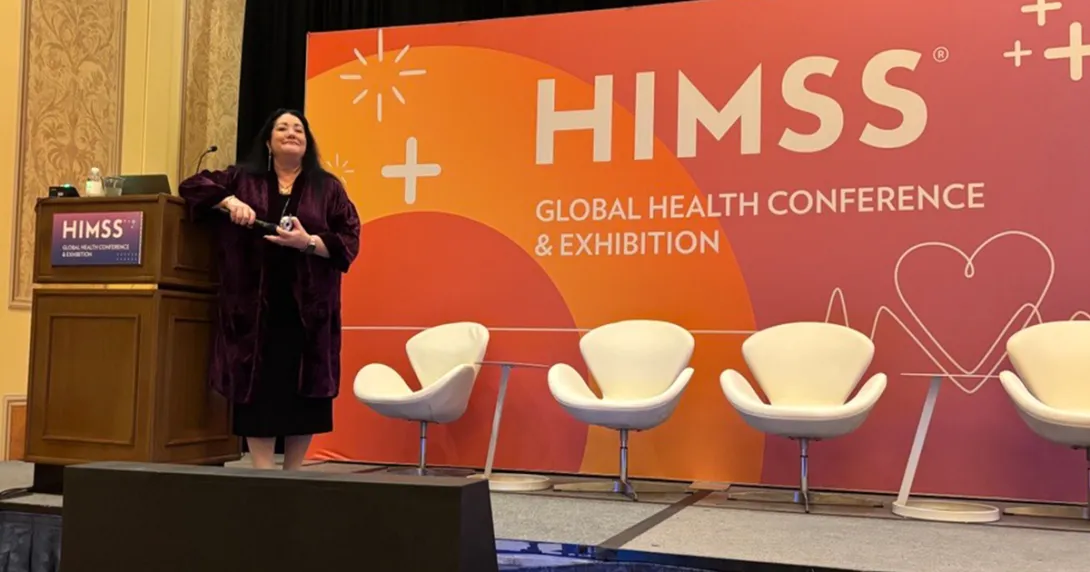
Didi Davis, vice president of informatics, conformance and interoperability at The Sequoia Project, speaks at HIMSS26 in Las Vegas.
Photo: Andrea Fox/HIMSS Media
LAS VEGAS – Improving trust in data exchange depends on ensuring data provenance and understanding its importance, said Didi Davis, vice president of informatics, conformance and interoperability at The Sequoia Project.
"Where did the data come from? Who was the author of that data? [What were] the date and time that it was created? Because that is important for people to understand," she said on Tuesday at the 2026 HIMSS Global Conference & Exhibition here. "Is this the data that's relevant for what I need to take care of for this patient?"
Davis' HIMSS26 session, "Building Trust and Confidence Through Better Healthcare Data Quality and Usability," aimed to provide a high-level overview of how her organization's Data Usability Workgroup USCDI v3 guidance for narratives, lab data and other elements can help evaluate trust within clinical workflows. It can also help health systems plan their standards implementation roadmaps across provider, public health and consumer use cases.
Health data traceability and integrity can make a difference to every organization, doctor and patient. But "data quality is not an easy thing to fix," said Davis, who is also a co-chair of HL7.
While the project's first full guide was "a baby step" that addressed the four classes of data, the second guide released in December 2024 "raised the bar significantly," covering all USCDI v3 classes.
The 60-page guide's seven chapters have use cases for the three key areas of data exchange – provider to provider, provider to public health agency and healthcare entity to consumer.
"Anywhere you get care," said Davis.
Chapter one of the guidance begins by defining data provenance and traceability across the care continuum.
While data might be created with a provider, it can go through many mechanisms, such as cancer registries and health information exchanges, Davis noted.
Most of the time, "hospitals that get data from one provider don't necessarily keep where it came from originally," she said. "Guess what? That causes duplicates."
Now, the standard is to keep the previous source it came from.
The following chapters address basic use cases for effective use of codes across the care continuum – keep the original code before recording – and reducing the impact of duplicates by using a persistent ID so that data can be deduplicated.
"When you receive the data, it allows you to reconcile it and identify the duplicates very quickly because the computer can slice and dice that much quicker than you can looking at it," Davis said.
The chapter on data integrity, format and trust, aka patient matching, focuses on normalizing patient demographics. Then, the following two chapters address identifying metadata standards and making sure patient information is grouped properly and narratives are easily retrievable, so downstream physicians don't have to dig to find them.
The final chapter on laboratory interoperability, which Davis called "a hot mess," shows the whole workflow from ordering to results. She said Sequoia worked with HL7 to create a "mapping table" to make standards easy to find.
Of note, while this chapter goes beyond USCDI v3, many public health data classes that are lab-associated appear in later USCDI versions and can seed downstream success.
Davis then asked attendees to help ensure data standards take hold.
"We didn't want guidance to just sit on a shelf and collect dust," she said.
With Taking Root, the non-profit organization aims to improve the completeness and usability of data through the adoption of guidance that promotes consistency across technologies. It's a community of practice that offers technical assistance and testing platform services.
"It’s one thing to get health data to the right place at the right time; it’s quite another to make sure that data is complete and useful for the purpose at hand," the Taking Root Implementer pledge agreement says.
Three federal agencies – the U.S. Office of Veterans Affairs, the Social Security Administration and the National Institute of Health – have taken the voluntary commitment along with more than 30 other organizations to adopt a "usability-in-all-projects" approach, Davis said.
Davis told Healthcare IT News after her session that while the pledge focuses on implementing specific data guidance, she came to HIMSS26 to help providers and vendors understand that The Sequoia Project's guidance, validator tools and readiness checklist are a blueprint to reduce duplicates and end data sharing challenges. It's a reference for providers to speak to their vendors and make changes, and for vendors to update their products.
"We're trying to educate factions and inspire you," she told session attendees.
"It is work … I admit," she said. "But if we don't do it, [artificial intelligence], clinical decision support, all these things you're hearing about on the show floor, they're not going to work as well."
Andrea Fox is senior editor of Healthcare IT News.
Email: afox@himss.org
Healthcare IT News is a HIMSS Media publication.


