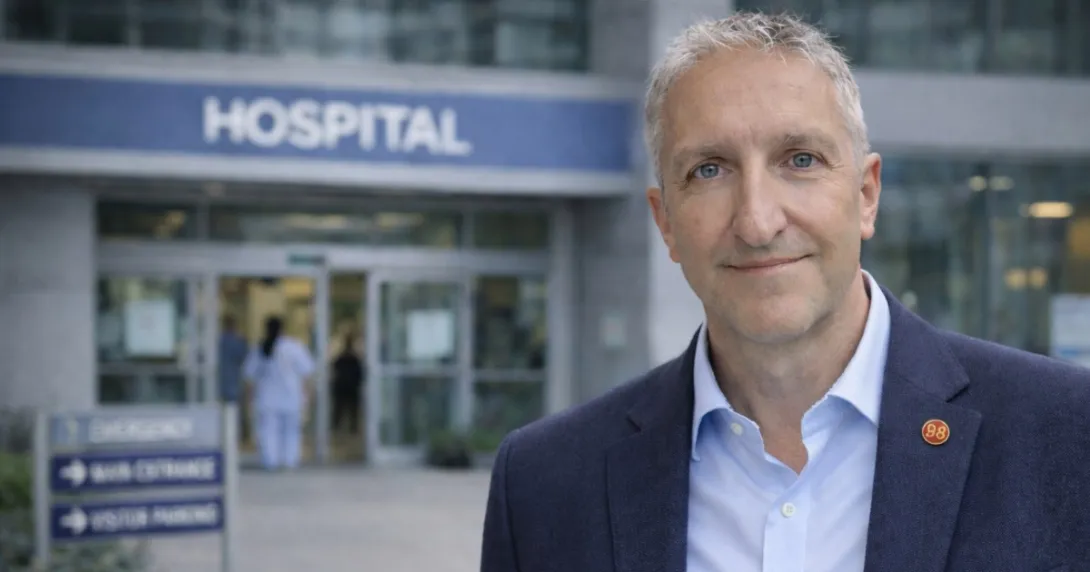
Andy Truscott, health technology lead at consulting firm giant Accenture
Photo: Accenture
For consulting firm giant Accenture, the biggest issue at the upcoming 2026 HIMSS Global Health Conference & Exhibition will not be artificial intelligence innovation – it will be AI accountability.
"Healthcare has spent the last three years experimenting – ambient documentation, imaging copilots, generative patient messaging, revenue cycle automation," noted Andy Truscott, Accenture's health technology lead. "Most of it works in controlled settings. That is no longer impressive.
"The real story now is this: AI is quietly becoming part of clinical and operational decision making before most organizations have the governance, monitoring or operating model to manage it," he continued. "That is dangerous."
Who is accountable?
For Truscott, the question no longer is, "Can AI help?" The question is, "Who is accountable when it is wrong, biased, out of date or misused?"
"We are entering a phase where AI is influencing documentation, coding, triage, treatment recommendations and capacity management," he said. "That is clinical infrastructure. If AI is infrastructure, it must be governed like infrastructure. Monitored like infrastructure. Stress-tested like infrastructure.
"HIMSS26 will feature a lot of AI demos," he continued. "The real conversation should be about industrializing AI safely at scale. The organizations that understand that distinction will move ahead. The ones that treat AI like a feature upgrade will create avoidable risk. Execution is the story. Oversight is the tension."
So, what should provider organization health IT leaders be doing right now? He advised CIOs should stop asking, "What AI tools should we buy?" and start asking, "What decisions are we willing to let AI influence?"
What will AI influence?
"That is a different conversation," Truscott explained. "First, define enterprise accountability. Who owns model performance? Who monitors drift? Who signs off on clinical impact? If those answers are unclear, scaling should stop.
"Second, tie every AI deployment to measurable operational or clinical outcomes," he continued. "If it does not reduce cognitive burden, improve throughput, improve quality or reduce cost, it is not innovation. It is distraction."
Third, build AI into the operating model, not the innovation lab, he added.
"That means lifecycle management, auditability, version control, change management and workforce education," he said. "AI should be treated like a clinical device, not an app.
"Finally, prepare the workforce," he continued. "The real transformation is not automation. It is augmentation. Clinicians and operators must understand where AI supports them and where it does not. Blind trust and blanket resistance are equally risky."
The next 24 months
The organizations that move fastest over the next 24 months will not be the most experimental – they will be the most disciplined, he added.
Asked what Accenture's main message to HIMSS26 attendees will be, Truscott said it is a simple but uncomfortable one.
"AI will either humanize healthcare or fragment it – there is no neutral path," he stated. "If deployed without governance, AI increases noise, risk and inequity. If deployed deliberately, with a strong digital core and clear accountability, it reduces burden, improves access and strengthens clinical judgment. Healthcare does not need more pilots. It needs scaled, governed capability.
"We are focused on helping health systems move from enthusiasm to execution," he continued. "That means embedding AI into real workflows, aligning it to measurable outcomes, and building the digital, data and governance backbone required to run it responsibly."
The industry has already proven AI can work – the next test is whether healthcare can run it safely, sustainably and at scale, he added.
Accenture will be in booth 4060 in the HIMSS26 exhibition hall.
Follow Bill's health IT coverage on LinkedIn: Bill Siwicki
Email him: bsiwicki@himss.org
Healthcare IT News is a HIMSS Media publication.
WATCH NOW: The model context protocol at work in AI and clinical workflows


