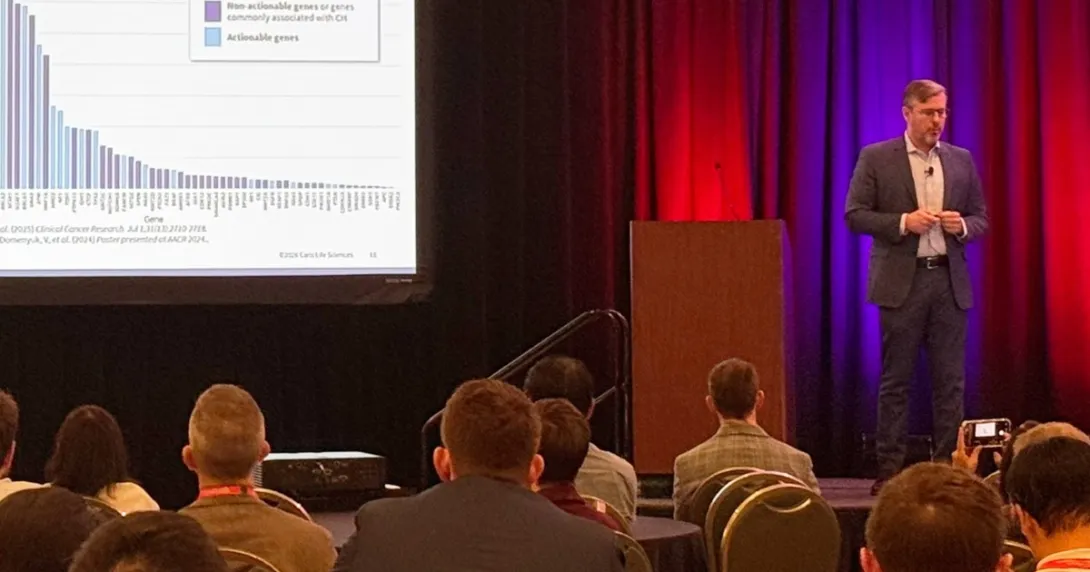
Dr. Matthew Oberley, senior vice president, chief clinical officer and pathologist-in-chief at Caris Life Sciences
Photo: Caris Life Sciences
Caris Life Sciences, an AI-powered biotech and precision medicine company, has published a new study in JAMA Network Open titled, "An AI Approach to Differentiating Lung Squamous Cell Carcinoma From Metastases of Other Origins."
The company says the report builds on the body of evidence showing the effectiveness of its proprietary GPSai algorithm over traditional diagnostic procedures in correctly diagnosing cancer types.
The paper demonstrates that by including AI algorithms as part of routine comprehensive molecular profiling, clinicians can uncover clinically significant misdiagnoses in cases labeled as lung squamous cell carcinoma, influencing treatment decisions and patient outcomes, explained Dr. Matthew Oberley, chief clinical officer and pathologist-in-chief at Caris Life Sciences.
"Our study examined nearly 4,000 cases that had been submitted for molecular profiling with a presumed diagnosis of primary lung squamous cell carcinoma, a category of cancer that can be difficult to distinguish from metastatic SCCs originating from other sites in the body, as SCC can arise from many anatomic locations in humans," said Oberley.
"By applying an AI-driven tissue-of-origin model alongside clinical, molecular and immunohistochemical evidence, we identified a meaningful subset of misdiagnosed cases," he continued. "123 out of 3,958 cases – approximately 3.1% – were ultimately determined to be misdiagnosed, representing SCC that had metastasized to the lung from other primary sites."
AI model corroboration
The misclassified tumors spanned a range of origins, including cutaneous, head and neck, urothelial, and thymic carcinomas. In most cases, the AI model's prediction was corroborated by additional orthogonal evidence such as genomic signatures, immunohistochemistry or clinical history. Importantly, the study found that in roughly three-quarters of these cases, the corrected diagnoses aligned with known clinical or imaging findings, reinforcing the validity of the revised classification, he added.
"Perhaps most clinically significant, in the majority of cases, the diagnostic changes would lead to different first-line treatment recommendations under established clinical guidelines," Oberley noted. "This highlights that even a relatively small misdiagnosis rate can have outsized implications for patient care, particularly when the tumor is initially perceived to be early-stage lung cancer but turns out to represent metastatic disease.
"The central advantage of AI in this context is its ability to synthesize complex, multidimensional data at scale," he continued. "Traditional pathology relies on the appearance of the tumor under the microscope and a limited set of biomarkers. SCC looks similar under the microscope regardless of its origin. AI, by contrast, integrates gene expression, genomic alterations and other molecular signals simultaneously, allowing it to detect patterns that are readily missed through conventional methods."
Another key strength is that AI operates as a consistent, always-on screening tool, he added.
"In this study, the AI model was applied to every case undergoing molecular profiling, regardless of prior suspicion of misdiagnosis," he explained. "This is important because many diagnostic errors persist simply due to a lack of suspicion or incomplete clinical context. By flagging discordant cases systematically, AI introduces a form of quality control that functions independently of individual vigilance or experience.
"AI excels in identifying subtle molecular 'signatures' that point to a tumor's origin, such as UV-induced mutations in skin cancers or pathogen-associated signals like human papilloma virus infection," he continued. "These signals may be technically detectable by humans, if considered, but are rarely assessed comprehensively or in combination during routine workflows."
AI's edge lies in its ability to integrate disparate data streams into a single probabilistic assessment, effectively augmenting human expertise, he added.
Substantial suboptimal care
At scale, even a modest misdiagnosis rate can translate into a substantial number of patients receiving suboptimal care, Oberley explained.
"The study suggests that if similar rates hold broadly, thousands of patients each year could be affected by incorrect tumor classification in just one cancer subtype," he said. "Deploying AI systematically across diagnostic workflows could, therefore, have a meaningful impact by reducing these errors and ensuring that more patients receive therapies aligned with the true biology of their disease.
"The implications extend beyond individual diagnoses to the overall efficiency and consistency of cancer care," he continued. "By standardizing the evaluation of tumor origin across institutions and care settings, AI has the potential to reduce variability in diagnostic quality. This could be particularly valuable in community settings or regions with limited subspecialty expertise, effectively democratizing access to advanced diagnostic capabilities."
More broadly, widespread adoption of such technology could accelerate the shift toward precision oncology, he added.
"Accurate identification of tumor origin is foundational to selecting the appropriate oncology therapy, enrolling patients in clinical trials and predicting outcomes," he concluded. "As AI becomes more integrated into routine care, it may correct errors and uncover previously unrecognized disease patterns, ultimately contributing to more personalized, data-driven cancer treatment at population scale."
Follow Bill's health IT coverage on LinkedIn: Bill Siwicki
Email him: bsiwicki@himss.org
Healthcare IT News is a HIMSS Media publication.
WATCH NOW: Agentic AI can turn clinical notes into insights


