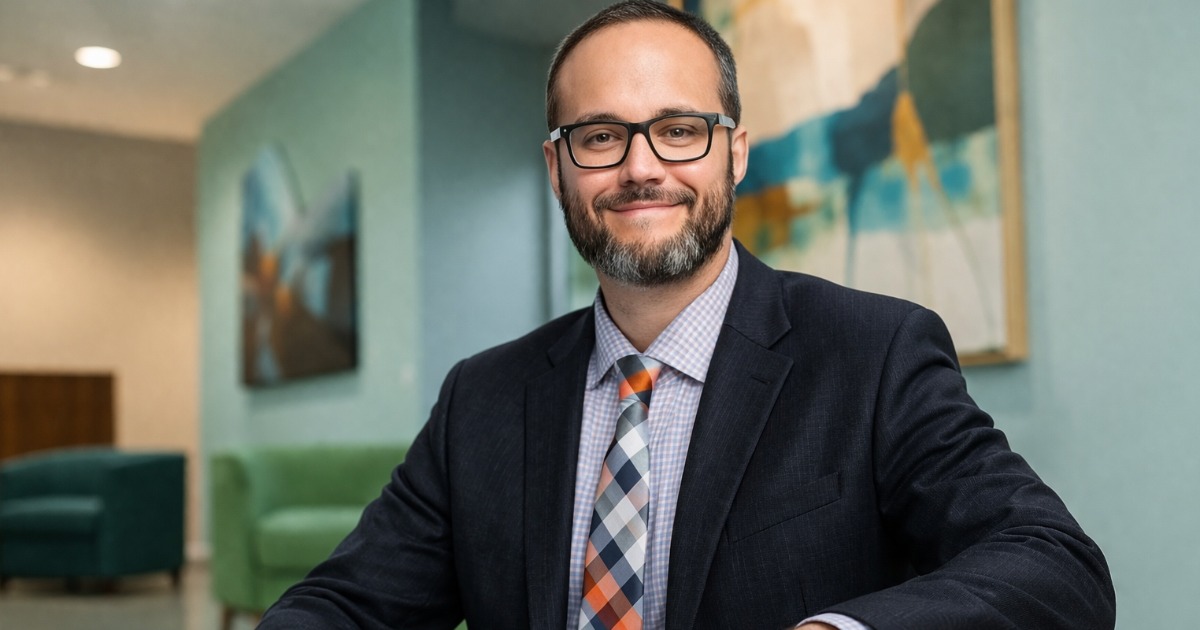
Edward Marx, CEO of Marx Advisory, an IT strategy and management consulting firm
Photo: Edward Marx
Concierge healthcare – where well-off patients who typically already have insurance pay an extra premium, sometimes a big one, to get greater attention and personalization from their care teams – is gaining in popularity.
With concierge care, for example, someone wants to be able to text their physician 24/7. And if they need to see a doctor, they want to see that doctor within 24 hours – and sometimes even at home.
Consumers pay a premium price for concierge healthcare and in return get more of their physician's attention. Where a traditional primary care physician might have a panel of 2,500 to 3,000 patients, for instance, a concierge doc might typically have just 500 or so.
Now there's a new type of concierge healthcare on the rise. Still in the early stages of development, AI concierge healthcare could represent a new and leading-edge care model, says Edward Marx, CEO of Marx Advisory, an IT strategy and management consulting firm.
"AI has the ability to help in providing that level of high-touch service so patients don't have to wait forever to see a specialist or get a test or test result," Marx explained. "It really cuts everything in half – combining a really good PCP, with their current panel, and artificial intelligence.
"And keep in mind, there's a physician recruitment issue – there are not enough physicians," he continued. "In the future, a PCP in AI concierge could probably have a panel of 25,000 [patients], not 2,500. It's remarkable. And it's mediating primary care and specialty care to some degree, as we know it."
We spoke with Marx to get a better understanding of his ideas about AI concierge healthcare, how it could be put to work and what it might mean for existing provider organizations.
Q. What is happening with patients and AI today that could be threatening hospitals?
A. Patients are becoming more independent of the hospitals than they ever have in the past because of AI. As we know, there's been a longstanding effort to improve patient experience, because the experience is not very good in most cases. It's hard to get an appointment and takes so long to see a specialist – a lot of different things that frustrate patients.
In AI, patients now have a tool where they can bypass a lot of that and just try to do a lot of self-care. And that's going to be a major disruption because how do hospitals make money? It's on the front-end with primary care. And primary care then refers to specialists who refer to the hospital. And hospitals as parts of health systems obviously have a lot of primary care themselves within their organization.
So, if AI causes primary care not to be used by patients as much as it has been in the past, it's going to be a pretty big financial hit. That's the major threat. And hospitals haven't shown a propensity to react quickly to changing environments. We all know we're very traditional, and there's good reasons for it.
I'll never knock the reasons why we're traditional and slow to move, but we are slow to move. The next threat that's going to come is we're going to be slow to move to meet the patients where they want to be with AI. And there's going to be a third party that probably is not even in existence today. It's going to come in and take that space.
Q. To get started, how can hospitals or health systems or group practices jump into an AI concierge healthcare program?
A. Hospitals must immediately become multi-model. Meet patients in the channel of their choice. So, let's take PCP as the first channel. You would have a traditional PCP like we have today. Or, in a second channel, you can do a virtual PCP via telehealth and only come in when you have to, like for an annual physical.
Then the third channel is Ai concierge healthcare. You know your PCP sits at the top to oversee, but most interactions are with AI chat agents. You use the hospital's LLM – an AI app – and you do a lot of the care yourself. If it suggests a lab, it automatically issues the order and gives you choices where to fill it. Everything is automated and you do things yourself – unless there is a major issue, like your lab test came back and you have a cancer diagnosis.
I'm really sounding the alarm on this because I believe it's a true disintermediation that's going to happen in the market. We know that from the "innovator's dilemma" and all that Clayton Christensen academic work that was done and how these stoic organizations or industries think they've got control and they move really slowly because they're not worried about any disruptors.
And all of a sudden a disruptor happens. A true disruptor really hasn't happened yet in the industry. But now, with AI, because of the speed, everyone knows what AI brings to the table, the speed that we can get answers and how AI self-evolves. It's completely different than anything we've ever seen.
Case in point on how healthcare is slow to adopt new technologies: We've got all this virtual care and remote patient monitoring. There's no reason why we shouldn't cut way back on the number of hospitalizations. There's no reason why we should make people drive in a car to go see someone to talk to you for five minutes and then drive back in your car and take an entire half day for just a regular medical appointment.
I don't see many healthcare organizations pushing virtual care. They want you to come in. So, I'm afraid it'll be the same with AI. So, to your question on AI concierge healthcare, what hospitals should be doing is being bimodal: Adopt all these different modalities and meet patients in the channel they want to be seen in.
Q. It's early. Are you seeing any outcomes today with AI concierge healthcare programs across the country?
A. It's all anecdotal. I've not discovered a complete study yet, but I think we'll see them coming out soon as this becomes more popular. What I'm hearing from people is the experience is better, the cost in the end is much lower, and the time to treatment is cut dramatically.
I'll give you a personal example of my experience with AI concierge. I went to get my physical in person. Every year, I go in March, and we take a lab as part of the physical. And this particular year I found I had a couple of markers that were elevated, still in normal range, but suggested something wrong with my liver.
My PCP, she wrote it off. She's a great doctor, but she wrote it off because it was just elevated a bit. It wasn't out of range. But I've seen this story before. I've had cancer in the past, and then I followed the doctor's best practices, and I took great comfort and confidence at the time following the doctor's best practices. And by doing that, it took many years until they finally realized I had stage three cancer.
So, I'm not going down that route again, right? So, I see this liver marker elevated. I text with my PCP. And I say, "Hey, I need another lab in six weeks." So I went, got another lab in six weeks. And again, I didn't need my PCP, except that someone had to give me the lab order. So, basically a text message, I get an order. This can all be automated. Didn't require a physician. I go back in. My numbers continue to elevate.
So, I put it in the AI LLM. I use ones like PopAI and Grok. It says, "You might want to see a nephrologist, it could be a couple of different things." And my physician, she acquiesces to a nephrology appointment.
The nephrology appointment, the earliest was five months. I live in Dallas-Fort Worth. There's a lot of nephrologists here. When I talk to people around the country, sometimes to see their PCP it's eight to 10 weeks. It's just crazy. I've seen this cancer story before. I'm a little concerned. So, I took another test six weeks later, and sure enough, I was in the danger range.
I watched the marker elevate over the course of four months, and now it's danger. So I went back to the AI chat, put in all my results again, and AI basically said, "Why don't you try these two things?" And I said, "That's going to be pretty easy." Basically it was eliminating anything that potentially could be nefarious.
So, per AI, I got rid of all my vitamins and supplements. I took the test again six weeks later, and my liver results were back to normal. I canceled the nephrology appointment. Think about this. Had I kept going through the November specialist appointment, what was going on with my liver could have become irreversible, it could have damaged my liver while I was waiting.
I'm happier because, one, it was really inexpensive, and it was really fast. I should have done it as soon as I got the first blood test. As soon as I saw an elevated marker. And that's what I've learned from all this, I'm going to do AI concierge even sooner.
And that's what people are doing in concert with their providers. They're educating themselves. They're taking their results, their lab results, their medical records, putting them into AI chat, and allowing AI chat to give them immediate feedback on things to be concerned about.
And again, I tested it with my PCP, and she agreed. So, I was doing both at the same time. But it's a shame, right? That it would have taken five or six months for me to get to a nephrologist, and I could have damaged my liver.
As for the AI apps, I trust but verify for now until I can gain more confidence in them. For primary care, I trust AI. When it came to my knee, another example, I still used an orthopedic doctor – and it turned out he was using the same AI as me.
So, what are the outcomes we're seeing? Anecdotally, my story is representative of many: faster time to treatment, more accurate diagnosis, less cost. I would have spent a half-day, right? Because by the time you get in your car, you drive across town, you wait in the waiting room, you fill out a clipboard. And it's going to be the first time they're looking at your results. They're not looking at it ahead of time. And then they're going to say what? Basically, the same thing that AI chat just told me.
And physicians themselves now are starting to become more dependent on AI chat for obvious reasons. They're going to be doing the same thing. Think about that. They're going to be taking all this information. Maybe the medical record vendor does it for them behind the scenes. They're taking in all that information and presenting an outcome. They're using the same systems, basically, that you're using.
So, the patient is going to become empowered to a level of understanding, to a level of precision that used to require a physician. What does that mean for physicians? There's a shortage, so there's plenty of work to go around. But I think the PCP is going to become like a specialist that can handle a lot of different routine things that specialists would normally have to do.
Hospitals and group practices need to start offering this AI concierge healthcare service. And especially when you think about value-based care – this is a game changer. A way to make profit is in value-based care. Or if you're dealing with whole populations, making your populations healthier, you have to do it because otherwise, someone's going to come in. There's going to be a big tech player that comes in and does their own concierge AI.
Click here to view a brief video of bonus content where Marx discusses the board's role in healthcare AI adoption and how to combat government policy and regulation slowing AI adoption.
Follow Bill's health IT coverage on LinkedIn: Bill Siwicki
Email him: bsiwicki@himss.org
Healthcare IT News is a HIMSS Media publication.
The HIMSS AI & Cybersecurity Virtual Forum is free to attend on Nov. 18. Learn more and register.
WATCH NOW: Managing government policy and regulation in healthcare AI adoption